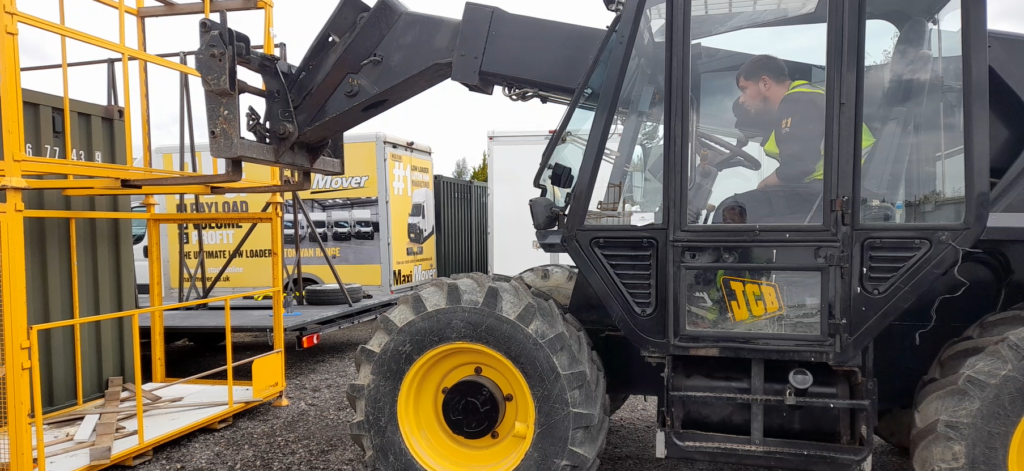
A telehandler turns up on site, a delivery needs lifting onto a mezzanine, and someone says: “Dave’s got his forklift licence, he can do it.”
We hear this on site more often than you’d think. It’s an understandable assumption. Both machines lift loads on forks, and both are covered by the same HSE guidance. But a forklift certificate does not make someone competent on a telehandler, and getting this wrong can lead to a serious accident and a very difficult conversation with the HSE.
The short answer: no
There is no single “forklift licence” that covers every type of lift truck. Operator training is specific to the type of machine. Someone trained on a counterbalance forklift is trained on a counterbalance forklift, not a reach truck, and not a telehandler.
If you want your forklift operators to use a telehandler, they need telehandler training. The good news is that experienced forklift operators can often take a shorter conversion course rather than starting from scratch.
Why a telehandler is so different from a forklift
A telehandler might look like a forklift with a long arm, but it behaves very differently:
- The boom changes everything. As the boom extends, the load moves further from the machine and its safe lifting capacity drops sharply. Operators must read and understand the load chart for every lift.
- Stability works differently. Lifting at height and at reach on a slope or soft ground can tip the machine. Operators need to judge ground conditions and use stabilisers correctly where fitted.
- Rough terrain. Telehandlers often work on building sites, farms and yards, not flat warehouse floors. Uneven ground, trenches and overhead hazards such as power lines are everyday risks.
- Different controls and steering modes. Many machines have two-wheel, four-wheel and crab steering, plus joystick boom controls that take practice to use smoothly.
- Visibility. The boom creates large blind spots, especially on the right-hand side, so planning the lift and using a banksman matter far more.
What the law and HSE guidance expect
Under the Provision and Use of Work Equipment Regulations 1998 (PUWER), employers must make sure anyone using work equipment has received adequate training. For lift trucks, the HSE’s Approved Code of Practice L117 sets out what that training should look like, and it applies to telehandlers as well as forklifts.
In practice, that means three stages of training:
- Basic training: the skills and knowledge to operate the machine safely.
- Specific job training: the machine, attachments and site conditions the operator will actually work with.
- Familiarisation: supervised time on the job under real working conditions.
If there is an incident, one of the first things an investigator will ask for is proof that the operator was trained on that type of machine. A counterbalance certificate won’t answer that question.
We covered how often refresher training is needed in our guide to refresher training under HSE L117. The same principles apply to telehandler operators.
Attachments need their own training too
One reason telehandlers are so useful is the range of attachments: buckets, jibs, fork positioners, and more. Each changes how the machine handles and what it can safely lift, and many reduce the rated capacity.
Operators should be trained on the specific attachments they will use, and the machine should carry the correct load chart for each one. If your team uses a telehandler with a jib or a bucket, make sure this is covered in their training.
Which telehandler course does your team need?
| Course | Who it’s for |
|---|---|
| Novice | No previous lift truck experience |
| Conversion | Trained and experienced forklift operators moving onto a telehandler |
| Refresher | Existing telehandler operators who need their skills checked and updated |
| Test only | Experienced operators with no current certificate, who need assessing |
Not sure which fits? Tell us about your operators’ experience and we’ll recommend the right course. There’s no point paying for a longer course than your team needs.
Why train on your own site?
Telehandlers are used in very different settings, from muddy building sites to farmyards and timber yards. Training on your own site means your operators learn on the machine they’ll actually use, in the conditions they’ll actually face. It’s the most practical way to cover specific job training as well as the basics.
It also saves time and cost. There’s no travel, no transporting machines, and less time away from work.
Book telehandler training with LP MHE Training
LP MHE Training delivers on-site forklift and telehandler training from our base in Heanor, Derbyshire. Our courses are AITT accredited, and we also deliver in-house courses as an ITSSAR-registered instructor, so you can choose the option that suits your business.
Whether you need to convert experienced forklift drivers or refresh your existing telehandler operators, get in touch for a quote. We’ll help you get the right training, done properly, on your own site.