Counterbalance or Reach Truck Training: Which Does Your Workplace Need?
Choosing the right forklift training starts with the work your employees actually do. Counterbalance and reach trucks are designed for different tasks and working environments, so the right option depends on your workplace layout, loads and equipment.
What is a counterbalance forklift?
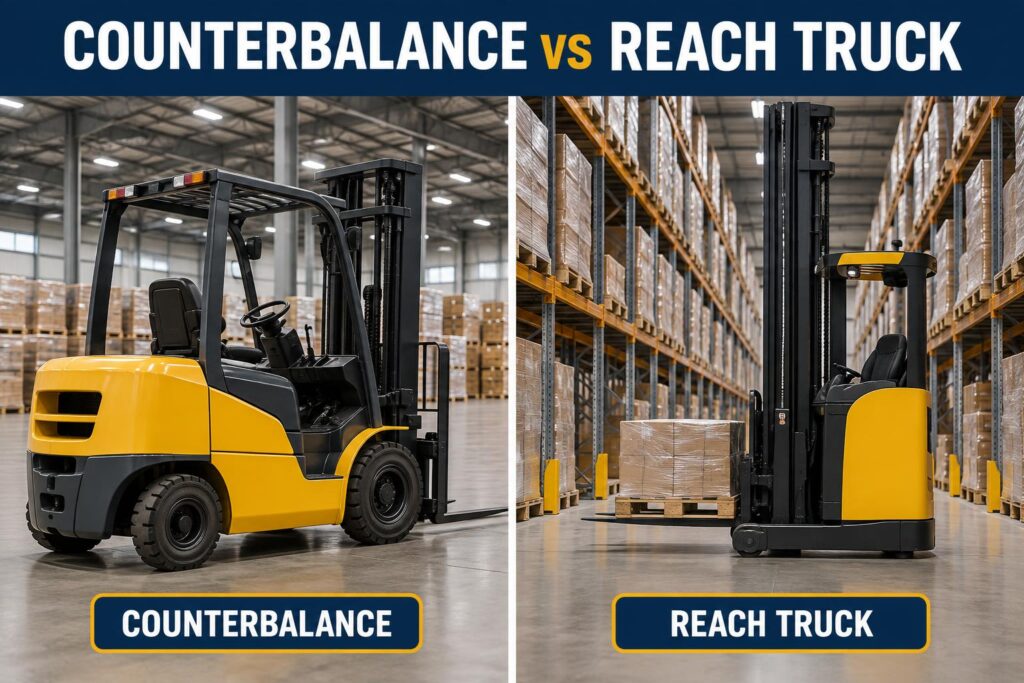
A counterbalance forklift carries its load at the front, balanced by a counterweight at the rear. It’s a versatile choice for businesses that need to move and stack loads in open areas, such as warehouses, yards and loading bays.
Before choosing one, consider the space available for turning and manoeuvring, the surfaces it will travel over, and the loads it needs to handle. The truck must also be suitable for the conditions where it will be used.
What is a reach truck?
Reach trucks are commonly used for pallet handling in warehouse racking, particularly where aisles are narrower and goods need to be stored at height. Their reach mechanism allows the forks to extend forwards to place or retrieve a load.
Think about your racking, aisle widths, floor conditions, pallet types and required lift heights. The truck and its attachments must be appropriate for the task, and operators need to understand the equipment they’ll use.
Key differences to consider
A counterbalance truck may suit a varied set of handling tasks where there’s room to manoeuvre. A reach truck may be more suitable for specific warehouse operations involving racking and narrower aisles.
Neither is automatically the better choice. The decision should reflect your site’s layout, equipment and day-to-day work. If your operation uses both truck types, employees may need training appropriate to each one.
What should employers consider?
Before arranging training, review:
- The truck types and attachments used at your site
- The loads employees will handle and where they’ll move them
- Racking, aisle widths, routes and pedestrian activity
- The operator’s previous experience and current competence
- How new skills will be practised under normal workplace conditions
HSE guidance describes lift-truck operator training as including basic training, specific job training and familiarisation training. The specific and familiarisation stages help connect the operator’s skills to the truck and workplace where they’ll be working. hse.gov.uk
Employers must ensure that workers receive adequate training for the equipment and work they undertake. The appropriate training depends on the job, the worker’s existing competence, the equipment and the workplace circumstances. hse.gov.uk
HSE guidance also explains that workplace lift-truck operators do not receive a government-issued driving licence; employers are responsible for ensuring operators are adequately trained and competent for the trucks they use. hse.gov.uk
Match training to the work
A course should reflect the operator’s experience and the truck they’ll use. A new operator, someone with experience on a different truck type, and an experienced operator returning for refresher training may have different training needs. Discuss your equipment and working environment with your training provider before booking.
LP MHE Training provides on-site forklift training for businesses across the East Midlands, with scheduling that can be adapted to suit workplace shift patterns. We can discuss counterbalance and reach truck training based on the equipment your team uses.
Need help choosing the right course for your workplace?
Contact LP MHE Training to discuss your trucks, staff experience and preferred training dates.
Before publishing, check that the contact link works on your site.